
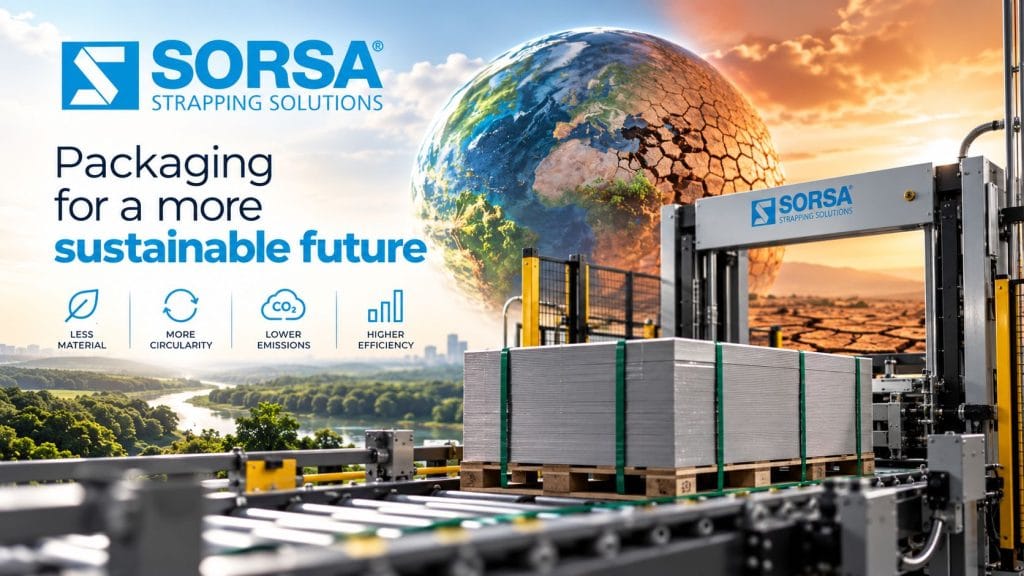
The meteorological disturbances resulting from climate change —such as extreme heat waves, sudden fluctuations in humidity, and episodes of intense cold— not only affect the global environment. In the industrial environment, these climate changes directly impact the physical and mechanical behavior of packaging consumables and the stability of loads during transport.
In Sorsa Packaging Systems, SA., As specialists with decades of experience in strapping and securing goods solutions, we analyze how to protect your supplies to avoid production losses and unplanned stoppages on the packaging line.
Why does climate change affect polyester (PET) strapping?
The polyester (PET) strapping It has become established as the ideal substitute for steel strapping due to its high toughness, elasticity, and shock absorption. However, being a polymeric material, it exhibits hygrothermal sensitivity:
- Thermal shocks and high temperatures: Prolonged exposure to heat or direct sunlight alters the modulus of elasticity of the plastic. This reduces the residual stress retained under load and can lead to deformation of the coil.
- Humidity variations: Environments with high relative humidity or condensation in the plant can superficially degrade the strapping and hinder friction welding or heat sealing in the heads of automatic strapping machines.
Poor storage combined with climatic variations increases the risk of mechanical breakage, welding failures, and unnecessary material waste.
Best practices for optimal storage of PET strapping
To ensure that the material maintains its breaking and elongation properties intact, in Sorsa We recommend following these storage guidelines:
- Protected location and thermal control
- Store the coils in covered, ventilated indoor areas away from exterior gates with direct currents.
- Avoid exposure to direct UV radiation (unprotected windows or skylights) and maintain a safe distance from direct sources of industrial heat (boilers, generators or radiators).
- Insulation from the ground and moisture
- Always keep the coils positioned vertically above wooden or plastic pallets, never directly on the pavement.
- Ensure a minimum distance from perimeter walls that may transfer moisture by capillary action.
- Pre-production acclimatization (24-hour rule)
- Place the PET strapping reels in the production or packaging area at least 24 hours before use.
- This acclimatization process stabilizes the polymer temperature to the working environment of the strapping machines, ensuring ideal welding performance.
Sustainability and operational efficiency with Sorsa Packaging Systems
Storing strapping correctly not only prevents operational failures; it is a key decision for the industrial sustainability:
- Waste reduction (Zero waste): You avoid the disposal of coils that are deformed or damaged by atmospheric agents.
- Sealing efficiency: The uniform temperature of the material reduces the energy required by the strapping machine to perform the heat sealing.
- Transportation safety: You ensure that the tension applied to the palletized goods remains constant throughout the logistics route.
In Sorsa Packaging Systems We help industries in all sectors to optimize their operating costs and environmental footprint through high-performance machinery and top-quality consumables.
Do you need technical advice for your packaging lines?
Contact our team of engineers and industrial strapping specialists to audit your packaging and material preservation processes.
 Español
 English
 Français