
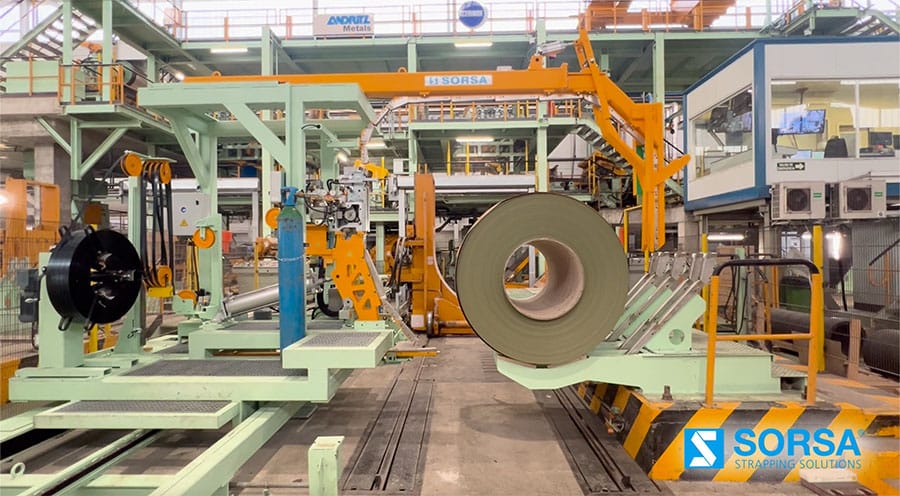
Sorsa's technical team has installed two industrial strapping machines on a continuous steel production line. The entire process—assembly, commissioning, adjustments, operator training, and technical service coordination—was completed in 5 days, and the assembly was carried out within a maximum downtime window of 12 hours to avoid disrupting the customer's production.
- 2 Industrial strapping machines installed and in production
- 5 days to complete assembly, commissioning and training
- 12 hours maximum line stop window
In the steel industry, installing a machine involves more than just designing and manufacturing it well. It also requires transporting it to the customer's plant, assembling it, and putting it into production. And that last part is often the most delicate.
The challenge: to install without stopping production
The client needed to add two new strapping machines to a steelmaking line that operates continuously. The condition was clear: The line could not be stopped for more than 12 hours.
This meant that two issues had to be resolved simultaneously:
- Fit the complete assembly of both machines into a very tight time window.
- Adapt to the means available at the client's facilities (access, space, lifting equipment and plant resources).
Why downtime is critical in the steel industry
Steelmaking lines represent very high investments and typically operate in continuous production. In this environment, every hour of downtime means lost production, delivery delays, and costs that affect the entire supply chain.
Therefore, when installing a strapping system at the end of the line, minimizing downtime is not a technical detail: it is a fundamental part of the project, on the same level as the machine itself.
How we did it: pre-planning and execution in 5 days
1. Planning of each operation
Before arriving at the plant, our technicians meticulously planned every step of the assembly process. The goal was to ensure that, when the shutdown window opened, nothing would remain undecided: work sequence, necessary resources, and coordination with the client's team.
2. 12-hour window assembly
The assembly of the two strapping machines was carried out within the agreed timeframe, adapting the work to the actual conditions of the plant and the resources available there.
3. Start-up and adjustments
With the machines assembled, the necessary start-up and adjustments were carried out so that the strapping would meet the line's requirements from the very beginning.
4. Training of operators
A strapping machine's performance is directly proportional to the team operating it. That's why we train the client's operators in the daily use of the machines, so they can work with them independently and safely.
5. Preparation and coordination of the technical service
We have prepared and coordinated the subsequent technical service, so that the client has a response after commissioning.
Project results
| Indicator | Result |
|---|---|
| Strapping machines installed | 2 |
| Total duration of the project in the plant | 5 days |
| Maximum line stop window | 12 hours |
| Scope | Assembly, commissioning, adjustments, training and technical service |
What should a supplier of industrial strapping machines offer?
The quality of an installation is not measured solely by the quality of the machine. It is also measured by the supplier's ability to:
- Plan the assembly correctly.
- Adapt to the actual conditions of the plant.
- Adhere to the agreed stopping windows.
- Put the installation into production quickly.
- Train the operators.
- Having a technical service capable of responding after commissioning.
If you are considering incorporating automatic or semi-automatic strapping systems into your line, these are the criteria you should review along with the technical specifications of each piece of equipment.
Our work ends when the client produces
Behind these results lies machinery, but above all, experience, planning, and qualified technicians. At Sorsa, we understand that our work doesn't end when we deliver a strapping machine: it ends when the customer can produce with it.
Frequently Asked Questions
How long does it take to install an industrial strapping machine?
It depends on the type of machine, the production line, and the plant conditions. In this project, the complete process for two strapping machines—assembly, commissioning, adjustments, and training—was completed in 5 days.
Is it possible to install a strapping machine without stopping the production line?
A stop is usually needed for assembly, but this can be greatly reduced with good pre-planning. In this case, assembly was scheduled within a maximum window of 12 hours.
Why is downtime so important in steelmaking?
Because steelmaking lines operate in continuous production and involve very high investments: every hour without production has a direct impact on productivity and delivery commitments.
What does the commissioning of a strapping machine include?
It includes starting up the machine, adjusting it to adapt it to actual production, training the operators, and coordinating the subsequent technical service.
What happens after installation?
The customer has access to Sorsa's technical service to resolve incidents, adjustments or maintenance once the line is in production.
Do you have an end-of-line strapping project? Speak to our technical team and we will plan the installation according to your plant's needs.
 Español
 English
 Français