
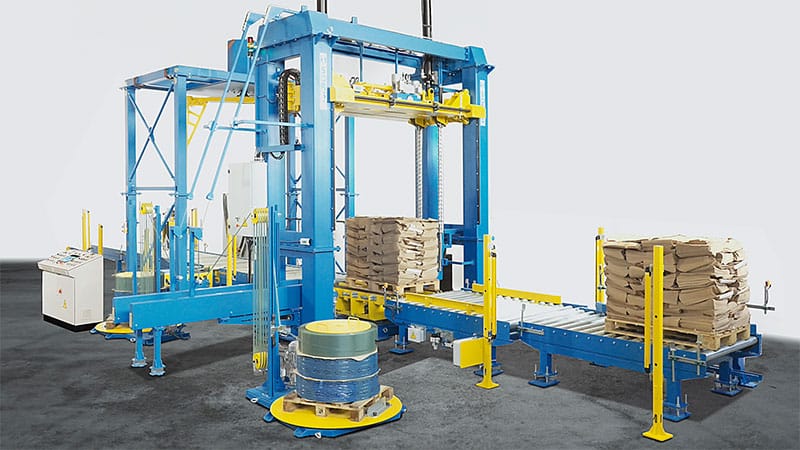
A pallet of paper bags presents one of the biggest logistical challenges for plant managers and intralogistics managers. Due to the nature of the material and the air trapped inside, the load tends to shift, sag, and deform during transport. In these scenarios, Strapping the load in the conventional way is not enough.
To ensure that the merchandise arrives intact to the end customer, it is essential to transform the unstable mass of sacks into a solid and compact block before securing it.
The logistical problem of paper bags
Paper bags accumulate air pockets and intermolecular space that are not eliminated solely by strapping tension. If the load is not compacted uniformly before being secured:
The movement of the truck redistributes the product inside.
The tension of the strap decreases halfway through its path.
The pallet loses its vertical geometry, which increases the risk of tipping, breakage, and costly returns at the destination.
The Sorsa solution: Mass compression + Cross strapping + Wrapping
To resolve the instability of deformable loads, the Sorsa FIP-800 2L/2K8000 + WRA 1212 automatic line Apply a three-step sequential stabilization strategy before and during load securing:
[1. Centering and Compression (up to 10 t)] ➔ [2. Cross Strapping] ➔ [3. Wrapping with Stretch Film]
1. Centering and compression up to 10 tons
Before the strapping touches the product, the machine centers the load and applies up to 10 tons of massive compression. This step evacuates the air trapped between the bags and settles the total mass on the base of the pallet.
2. Cross strapping with maximum tension
With the load perfectly compacted under pressure, the system applies high-tension cross-straps. By applying the strapping while the mass remains compressed, the tension is mechanically fixed without risk of subsequent loss of strength.
3. Wrapping film
To complete the process, the wrapping module applies stretch film around the block, protecting the structure against external moisture, dust, and tearing during handling.
Comprehensive control with Siemens PLC technology
The entire process of the FIP-800 2L/2K8000 + WRA 1212 line is automated and integrated by means of a Siemens PLC. This allows operators to precisely adjust key parameters such as:
Level and progression of pressure according to the weight of the bag.
Points and intensity of strapping.
Wrapping patterns for each type of format.
The result is a compact pallet, perfectly vertical and ready to withstand long-distance journeys.
Technical data sheet for the stabilization process
| Stage | Main action | Function in loading sacks |
| Alignment | Automatic pallet centering | It ensures the symmetry of the block on the vertical axis. |
| Pressing | Hydraulic compression up to 10 t | It eliminates internal air and stabilizes the geometry of the bulk. |
| Lashing | Automatic cross strapping | Secure the compacted structure while retaining maximum tension. |
| Protection | Wrapping with stretch film | Exterior sealing against environmental factors and friction. |
What is the most difficult type of pallet you have to ship?
Each type of deformable merchandise requires a customized pressure and restraint analysis. If you want to optimize your packaging line or evaluate the behavior of your palletized sacks, Contact the Sorsa Strapping technical team for a demonstration or feasibility study.
 Español
 English
 Français